
Warehouse Technology Advisor
Find Your Ideal Warehouse Technology
Answer a few quick questions to discover which warehouse technologies will give you the best return on investment based on your business size, order volume, and pain points.
Modern warehouses don’t look like the dusty, paper-filled storerooms of the 1990s. Today, they’re fast-moving, data-driven hubs where robots roll alongside humans, scanners beep every few seconds, and inventory counts update in real time. If you’re wondering what technology is used in warehouse management, the answer isn’t one tool-it’s a whole ecosystem working together to move goods faster, cheaper, and with fewer mistakes.
Warehouse Management Systems (WMS) Are the Brain
At the core of every smart warehouse is a Warehouse Management System (WMS). This isn’t just a fancy spreadsheet. It’s software that tells workers where to pick, where to pack, and when to reorder. A good WMS tracks every item from the moment it enters the warehouse until it ships out. It knows which items sell fastest, which bins are full, and which orders need to go out before the end of the shift.
Companies like DHL and Amazon use WMS platforms such as Manhattan Associates, SAP EWM, and Oracle WMS. But even small warehouses can use affordable cloud-based options like Fishbowl or NetSuite. These systems don’t just record data-they optimize it. For example, if a customer orders a product that’s stored in three different locations, the WMS will tell the picker to grab it from the closest spot to save time.
Barcodes and RFID: Seeing What’s Where
Before you can manage inventory, you need to know what’s there. That’s where barcodes and RFID come in. Barcodes are still everywhere because they’re cheap and reliable. A worker scans a barcode with a handheld device, and the WMS instantly updates the location and status of that item.
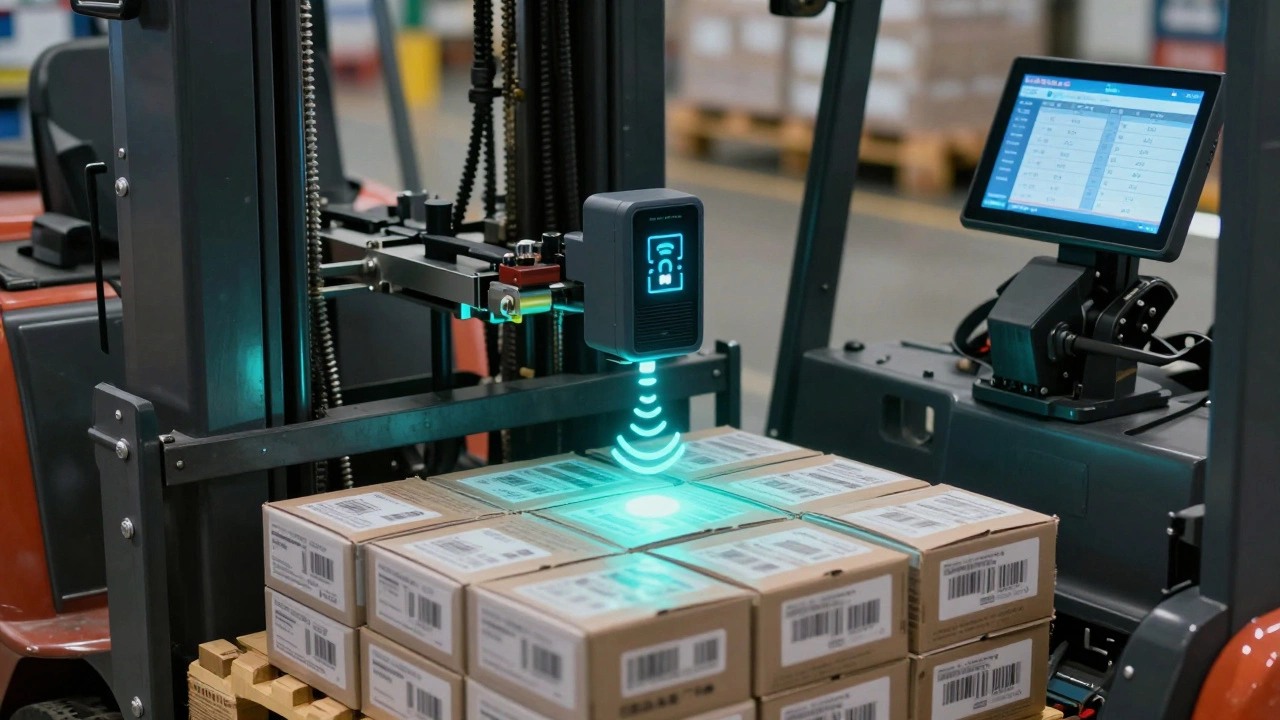
RFID (Radio-Frequency Identification) is the upgrade. Instead of scanning one item at a time, RFID tags can be read from several feet away-sometimes hundreds at once. A forklift with an RFID reader can drive past a pallet and automatically log all 500 boxes on it. This cuts counting time from hours to minutes. Retailers like Zara and Walmart use RFID to track everything from clothing to electronics. The tags cost a few cents each, and the savings in labor and lost stock make them worth it.
Automated Storage and Retrieval Systems (AS/RS)
Imagine a warehouse where shelves move on their own, and robots bring you the exact box you need. That’s an Automated Storage and Retrieval System (AS/RS). These systems use vertical carousels, shuttle racks, or robotic arms to store and retrieve goods without human intervention.
One common type is the vertical lift module (VLM). It looks like a tall cabinet with trays stacked inside. When an order comes in, the system finds the right tray, lifts it to the operator, and waits for them to grab what’s needed. It’s perfect for small, high-turnover items like screws, batteries, or pharmaceuticals. Another type is the horizontal carousel-think of a giant rotating wheel of bins. These systems can handle up to 100,000 items per hour and reduce picking errors by over 95%.
Automated Guided Vehicles (AGVs) and AMRs
Wheels, sensors, and software are replacing forklift drivers. Automated Guided Vehicles (AGVs) follow magnetic strips or laser paths to move pallets from one area to another. They’re reliable but rigid-change the layout, and you have to rewire the whole system.
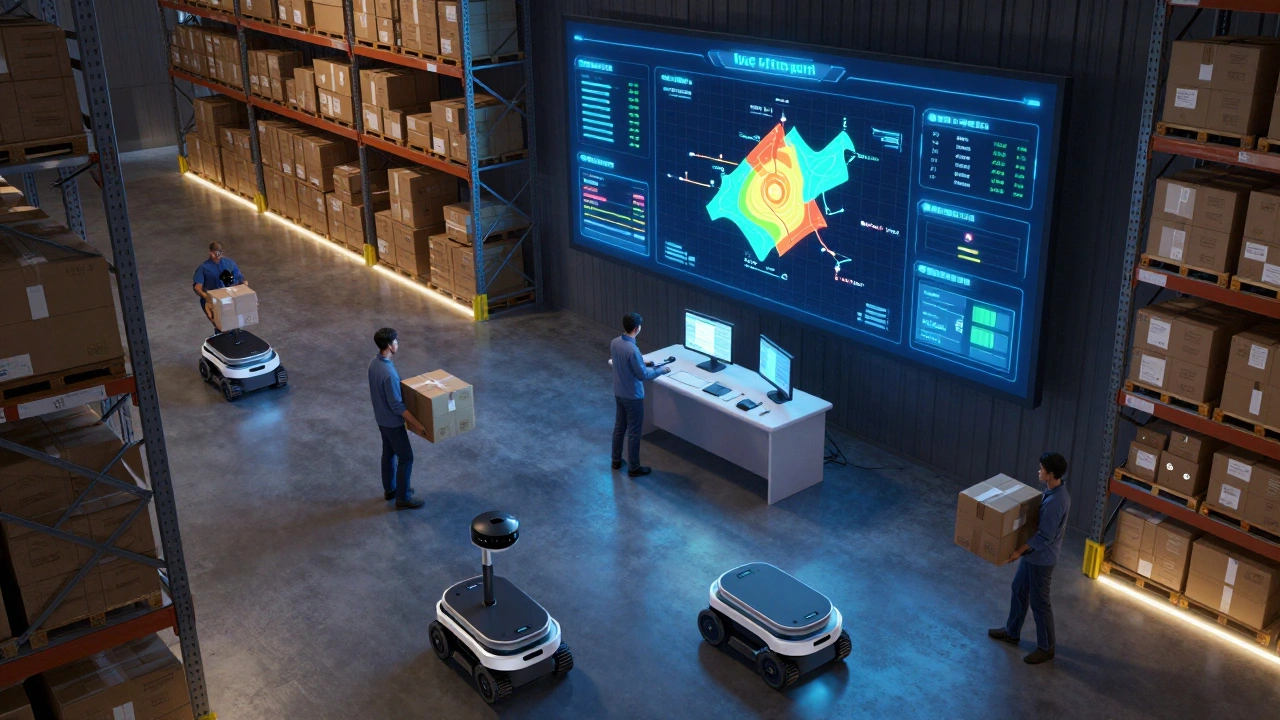
Enter Autonomous Mobile Robots (AMRs). These are smarter. They use cameras, LiDAR, and AI to navigate around people, obstacles, and changing warehouse floors. Companies like Amazon use over 750,000 AMRs in their fulfillment centers. These robots don’t need fixed tracks. They learn the warehouse layout on their own and find the fastest route to each order. One AMR can carry up to 1,500 pounds and work 24/7 without breaks.
Warehouse Robotics: Beyond the Robot Arm
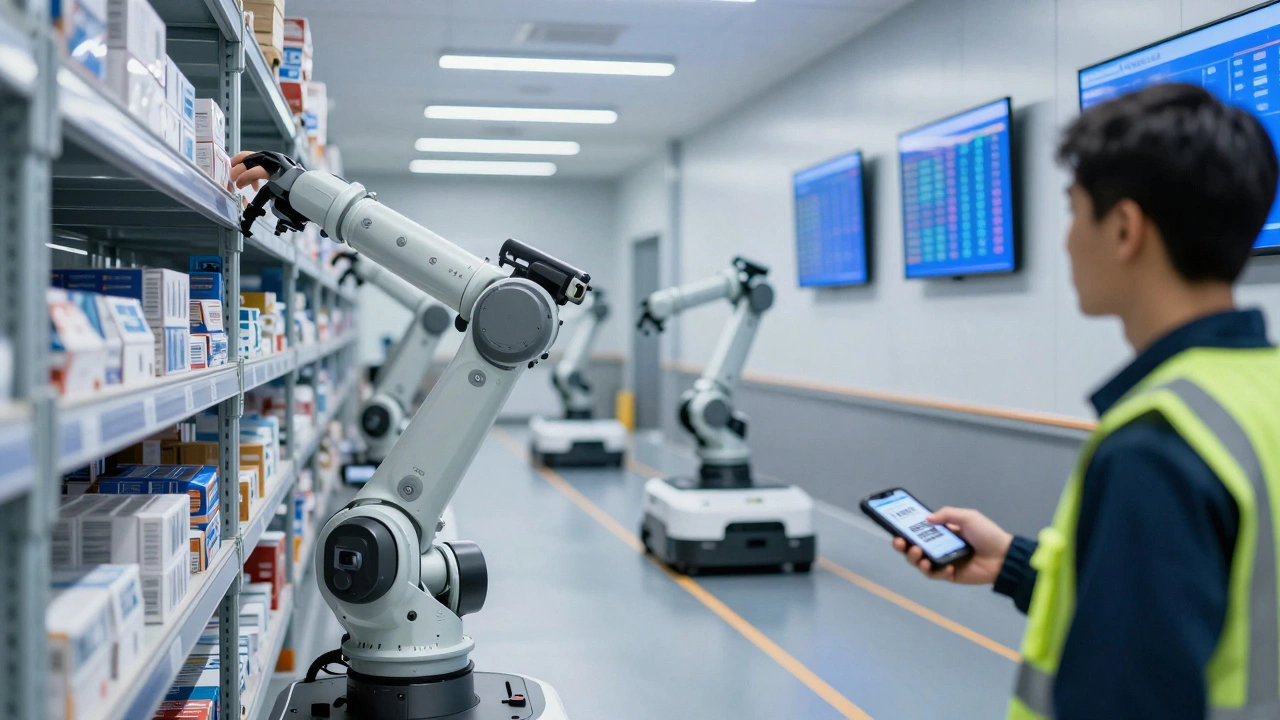
Robots aren’t just for moving boxes. New systems can pick items off shelves, pack them into boxes, and even label them. Picking used to be the most labor-intensive task in a warehouse. Now, companies like Ocado and 6 River Systems use robotic arms with computer vision to identify and grab products-whether they’re fragile, oddly shaped, or stacked haphazardly.
These robots use deep learning to recognize thousands of item types. One system can pick 800 items per hour, compared to a human’s average of 150. And they don’t get tired. At a warehouse in Manchester, a robotic picking system cut labor costs by 40% and increased accuracy to 99.98%.
Real-Time Data and IoT Sensors
Technology doesn’t just track inventory-it monitors conditions. IoT sensors placed on pallets or inside storage areas track temperature, humidity, and even vibration. This matters for food, medicine, or electronics. If a shipment of insulin is exposed to heat above 8°C, the sensor sends an alert. The warehouse team can intervene before the product spoils.
These sensors also help with maintenance. Motors on conveyor belts, forklift batteries, and robotic arms all have vibration and temperature sensors. If something starts overheating or vibrating abnormally, the system flags it before it breaks. This reduces downtime and keeps the warehouse running smoothly.
Integration: The Hidden Key
All this tech means nothing if it doesn’t talk to each other. The real magic happens when your WMS connects with your ERP, shipping software, and e-commerce platform. If a customer orders a product on Shopify, that order should automatically appear in the WMS. The picking robot should know where to go. The packing station should print the right label. The carrier should get the tracking number instantly.
Many warehouses fail because they use five different systems that don’t integrate. That’s why modern WMS platforms come with open APIs. They can plug into tools like FedEx Ship Manager, QuickBooks, or Microsoft Dynamics. The goal? Zero manual data entry. One system, one source of truth.
What’s Next? AI and Predictive Analytics
The next wave isn’t just automation-it’s prediction. AI looks at past sales, weather patterns, holidays, and even social media trends to forecast what will sell next. If a new video game drops on Friday, the system might move 200 units of the console to the front of the warehouse on Tuesday. It might even suggest ordering more batteries before the launch.
Some systems now predict when a machine will break, when a worker will need a break, or which orders are likely to be returned. One warehouse in Leeds reduced returns by 18% just by using AI to flag orders with mismatched packaging before they shipped.
This isn’t science fiction. It’s happening now. Companies that ignore these tools are falling behind. Those that adopt them see faster order fulfillment, lower labor costs, and fewer mistakes.
Where Do You Start?
You don’t need to buy robots tomorrow. Start small. If you’re still using paper pick lists, switch to barcode scanning. If you’re counting inventory monthly, move to weekly RFID scans. Upgrade your WMS to one that works on a tablet. Connect it to your online store.
Look for pain points: Where do delays happen? Where do mistakes occur? Where do workers spend the most time walking? Fix those first. Technology should solve real problems-not just look cool.
The goal isn’t to replace people. It’s to make them more powerful. A worker with a scanner and a tablet can do more than three workers with clipboards. And that’s the real advantage of modern warehouse technology.
What is the most important technology in warehouse management?
The most important technology is the Warehouse Management System (WMS). It’s the central brain that coordinates everything else-barcodes, robots, sensors, and shipping. Without a good WMS, even the fanciest robots won’t work efficiently. It turns raw data into action, telling workers where to go, what to pick, and when to reorder.
Can small warehouses afford modern warehouse technology?
Yes. Cloud-based WMS platforms like Fishbowl, Zoho Inventory, and Sortly start under £50 per month. Barcode scanners cost less than £100 each. Even RFID tags are affordable at around 10p per tag. Many small businesses start with just a tablet, a scanner, and a simple WMS. They add automation later as they grow. The key is to solve one problem at a time-not buy everything at once.
Do I need robots in my warehouse?
Not necessarily. Robots are great for high-volume operations, but they’re overkill for small or seasonal warehouses. If you ship fewer than 500 orders a day, focus on better software and scanning tools first. AMRs and robotic arms make sense when labor is expensive, orders are high, or errors are costly. For most small businesses, a good WMS and barcode system will give you 80% of the benefit for 20% of the cost.
How does RFID compare to barcodes?
Barcodes need a direct line of sight and one item at a time. RFID works through boxes, stacks, and even metal shelves. You can scan a whole pallet in seconds with RFID. Barcodes are cheaper and work fine for low-volume operations. RFID is faster and more accurate, especially for high-turnover or bulk inventory. Most warehouses use both: barcodes for individual items, RFID for pallets and containers.
What’s the biggest mistake warehouses make when adopting new technology?
Trying to automate everything at once. Many warehouses buy robots, sensors, and new software all in one go-and then get overwhelmed. The result? Staff resist change, systems don’t integrate, and ROI takes years. The best approach is to fix one bottleneck at a time. Start with inventory accuracy. Then speed up picking. Then reduce errors. Let each tech solution solve one clear problem before adding the next.