
International Mail Cost Calculator
Calculate Your Shipping Cost
Sending mail overseas isn’t just about sticking a stamp on an envelope anymore. In 2025, the cost to send international mail depends on where you’re sending it, how heavy it is, how fast you need it there, and even what you’re sending. There’s no single price tag-you could pay $2 or $150 for a package to go from New York to Tokyo, and both could be perfectly normal.
What You’re Really Paying For
When you pay for international mail, you’re not just covering the cost of a plane ride. You’re paying for customs processing, handling fees, fuel surcharges, and the infrastructure that moves your item across borders. The U.S. Postal Service (USPS) handles the first leg, but once your package leaves the U.S., foreign postal services take over. Each country charges its own fees, and those can vary wildly. A letter to Canada might cost less than a postcard to Brazil because Brazil has higher handling fees and stricter customs rules.
Think of it like a toll road. The U.S. charges you one fee to get on the highway, but every country you pass through adds its own toll. Some are small, like Canada or the U.K. Others, like Nigeria or Argentina, can add $10 or more just to clear customs.
Price Breakdown: Letters vs. Packages
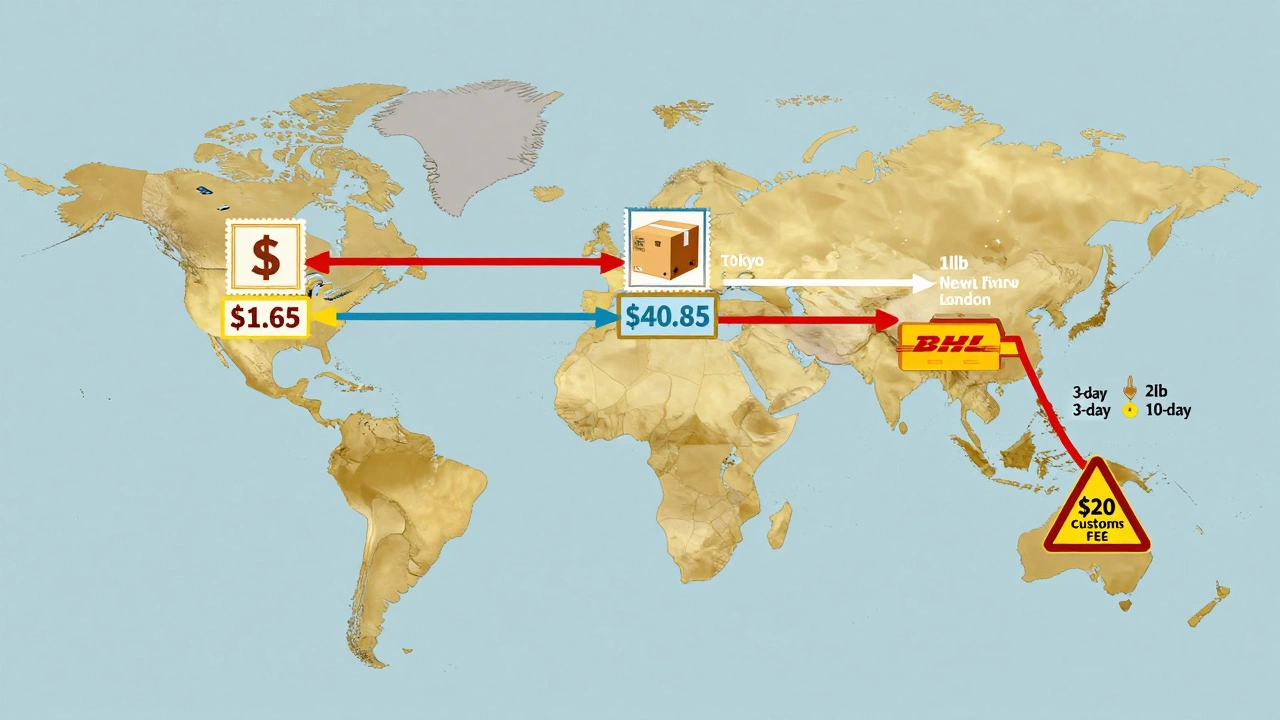
Letters and packages are priced completely differently. A standard postcard or letter under 1 ounce costs $1.65 to send anywhere in the world using USPS First-Class Mail International. That’s the cheapest option for paper-thank you, global postal agreement. But if you go over 1 ounce, the price jumps to $2.90 for up to 2 ounces, then $4.25 for up to 3 ounces. Beyond that, you’re better off using Priority Mail International.
For packages, things get more complex. Here’s what you’ll pay in 2025 for a small box sent via USPS Priority Mail International:
- Up to 1 lb: $34.55 to most countries
- Up to 2 lbs: $40.85
- Up to 4 lbs: $54.25
- Up to 10 lbs: $89.75
These prices cover tracking and insurance up to $100. If you need more coverage, you pay extra. And if you’re shipping to a remote location-say, the Faroe Islands or the Maldives-you’ll pay a surcharge. Some places add $15-$30 just because they’re hard to reach.
Speed Costs Money
Want it there in 3 days? That’s Priority Mail Express International. It starts at $49.25 for a 1-lb package and can hit $170 for 20 lbs. It’s the fastest option, with guaranteed delivery in 3-5 business days to most countries. But here’s the catch: not all countries accept it. Some, like Russia and North Korea, don’t allow express mail at all. Others, like India, hold it at customs for days before releasing it-even if you paid extra for speed.
For most people, Priority Mail International (6-10 business days) is the sweet spot. It’s reliable, reasonably priced, and includes tracking. Express is only worth it if you’re shipping legal documents, medical supplies, or a gift for someone’s birthday next week.
What You Can’t Send
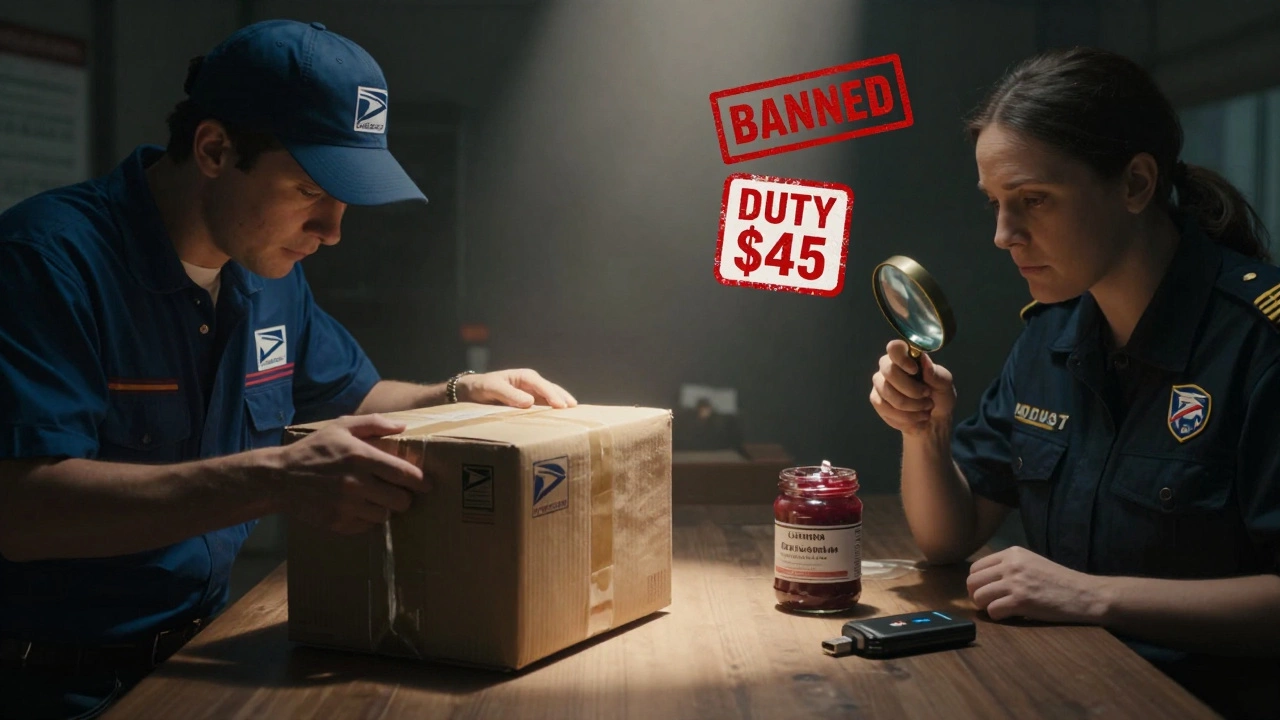
Some things are flat-out banned. Others are allowed but cost way more. The U.S. Postal Service blocks lithium batteries, alcohol, tobacco, live animals, and most food items from international mail. Even if you think it’s harmless-like a jar of homemade jam or a bottle of perfume-it might be flagged. If your package gets held at customs, you’ll get a notice. Paying a $20 fee to release it is common. If you don’t respond, the package gets returned or destroyed.
And if you’re shipping electronics? You need to declare the value and sometimes provide an invoice. A $50 phone might trigger a $15 customs duty in Germany. A $300 camera? You could owe $60 in taxes. That’s not a shipping fee-that’s a tax. And it’s not something USPS can predict or cover.
Alternatives to USPS
USPS is the cheapest for light items, but it’s not the only option. Private carriers like DHL, FedEx, and UPS offer faster service and better tracking-but at a steep price.
For a 2-lb package to the U.K.:
- USPS Priority Mail International: $40.85
- DHL Express: $112
- FedEx International Economy: $98
- UPS Worldwide Saver: $105
Private couriers are 2-3 times more expensive. But they’re better for high-value items, time-sensitive deliveries, or if you need to return something. They also handle customs paperwork for you. With USPS, you fill out forms yourself. With DHL, they do it. That convenience costs extra.
How to Save Money
You don’t have to pay full price every time. Here’s how to cut costs:
- Use flat-rate boxes. USPS lets you ship a 1-lb box anywhere in the world for $34.55, no matter how light it is. Pack it full of socks, books, or small gifts-it still costs the same.
- Ship during off-peak times. December is the most expensive month. Avoid sending gifts in the last two weeks of the year.
- Print labels online. USPS gives you a discount if you buy postage on usps.com. You save $0.50 on First-Class and $1.50 on Priority Mail.
- Use a third-party service like Pirate Ship or Shippo. They negotiate bulk rates and often beat USPS prices by 10-20%.
- Check destination country rules. Some countries, like Australia and New Zealand, charge extra for packages over 1 kg. If you can split your shipment into two smaller ones, you might avoid the fee.
Real-World Examples
Here’s what real people paid last month:
- A student sent a 5-lb box of textbooks to Mexico: $67.25 via USPS Priority Mail International. Took 8 days. No issues.
- A grandmother mailed a 1-lb package of cookies to her granddaughter in Japan: $34.55 using a flat-rate box. Customs opened it, held it for 3 days, then released it. No extra fee.
- A small business shipped 3 USB drives (total 0.5 lb) to Germany: $2.90 via First-Class Mail. No tracking. Package was lost. No refund.
- A freelancer sent a 12-lb package of electronics to Brazil: $132 via DHL. Paid $45 in customs duties. Took 12 days.
These examples show how unpredictable international mail can be. Price doesn’t guarantee delivery. Speed doesn’t guarantee clearance. And sometimes, the cheapest option is the riskiest.
What to Do If Your Package Gets Stuck
If your tracking says “held at customs” for more than 10 days, you need to act. First, check the destination country’s customs website. Most have online portals where you can search by tracking number. If you see a fee listed, pay it immediately. Delays cost more than fees.
Call your local post office. They can’t force customs to release your package, but they can check if it’s been returned or destroyed. If you didn’t insure it, you’re out of luck. That’s why insurance matters-even if it’s just $5 for $100 coverage.
Final Tip: Always Declare Accurately
Under-declaring value to avoid customs fees sounds smart. It’s not. If customs finds your item’s real value, they’ll charge you back taxes, plus a penalty. You might pay double what you expected. And your package could be seized. Always write the true value. It’s not about tricking the system-it’s about playing by the rules so your package actually arrives.
How much does it cost to send a letter overseas in 2025?
A standard letter or postcard under 1 ounce costs $1.65 to send anywhere in the world using USPS First-Class Mail International. Each additional ounce adds $1.25. Letters over 3 ounces are better shipped as packages using Priority Mail International.
What’s the cheapest way to send a package internationally?
The cheapest option is USPS Priority Mail International using a flat-rate box. For a 1-lb package, it’s $34.55 regardless of weight up to 20 lbs (within size limits). For lighter items under 1 lb, First-Class Mail International at $2.90 for 2 ounces is cheaper-but doesn’t include tracking.
Does DHL or FedEx cost less than USPS for international shipping?
No. DHL, FedEx, and UPS are typically 2-3 times more expensive than USPS for the same package. They’re faster and offer better tracking, but not cheaper. Use them only if you need guaranteed delivery in 2-3 days or are shipping high-value items.
Why is shipping to some countries so expensive?
Countries with remote locations, weak postal systems, or strict customs rules charge higher fees. Places like Papua New Guinea, Yemen, or Venezuela add $15-$40 in handling and customs fees on top of the base shipping cost. These aren’t charged by the U.S. Postal Service-they’re added by the destination country.
Can I send food or medicine internationally?
Most food items are banned from international mail, including meat, dairy, fresh fruit, and homemade baked goods. Medications are only allowed if they’re prescription drugs for personal use, clearly labeled, and under 90 days’ supply. Even then, some countries block them entirely. Always check the destination country’s rules before shipping.
What happens if my package gets lost?
If you used Priority Mail International and bought tracking and insurance, you can file a claim for up to $100 (or more if you paid extra). Without insurance, there’s no refund. First-Class Mail International has no tracking or compensation. Always insure valuable items-even if it’s just $5 extra.