
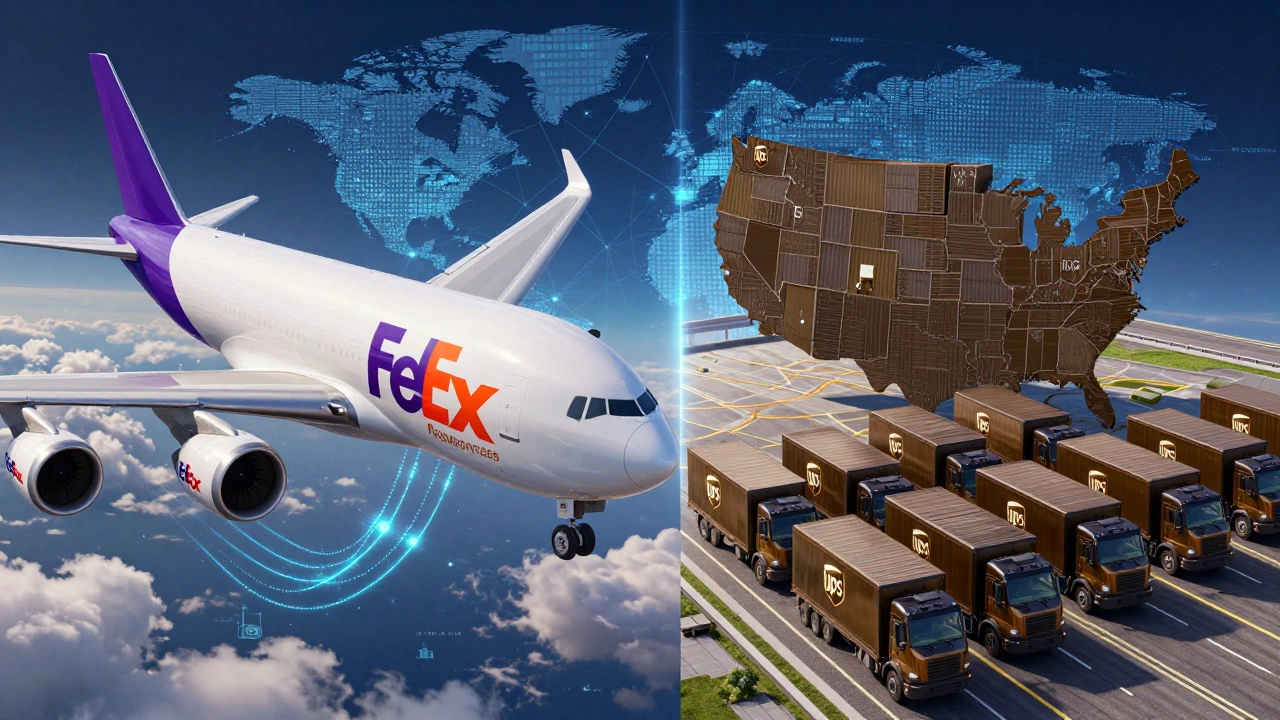
FedEx vs. UPS: The Logistics Showdown
Configure Your Scenario
Based on 2025/2026 industry data regarding revenue, fleet size, and package volume. Amazon Logistics excluded as it is not a standalone public carrier.
FedEx
The Revenue King- Revenue Share:
- Package Volume:
- Air Fleet Dominance:
UPS
The Volume Powerhouse- Revenue Share:
- Package Volume:
- Ground Network:
Key Takeaway:
Select your shipping criteria to see who wins: FedEx or UPS.
You see brown trucks and purple-and-orange jets everywhere. But when it comes to moving goods across America and around the world, one name usually sits at the top of the list by sheer size. If you are looking for the largest logistics company in the United States based on revenue, the answer is almost always FedEx. However, the title of "largest" can be tricky depending on whether you measure by money, volume of packages, or workforce.
In 2025 and heading into 2026, FedEx Corporation holds the crown for total annual revenue among pure-play logistics firms in the US. But its main rival, United Parcel Service (UPS), often beats it in package volume and profit margins. Understanding who is actually "biggest" requires looking beyond just the headline numbers. It involves examining their networks, their business models, and how they handle the massive shift toward e-commerce fulfillment.
Defining "Largest": Revenue vs. Volume
When people ask for the largest company, they usually mean revenue. In fiscal year 2024, FedEx reported revenues exceeding $90 billion. This makes it the biggest player financially. UPS, its closest competitor, reported revenues slightly lower, often hovering between $85 billion and $90 billion depending on fuel surcharges and economic conditions.
However, if you count by the number of packages delivered, the picture changes. UPS typically handles more daily package volumes than FedEx Ground because UPS owns a larger share of the residential delivery market through its ground network. FedEx relies heavily on its Express division for high-value, time-sensitive shipments, which generates higher revenue per package but fewer total units compared to standard ground shipping.
| Metric | FedEx | UPS | Amazon Logistics |
|---|---|---|---|
| Annual Revenue | $90B+ | $85B-$90B | Private (Est. $100B+ segment) |
| Daily Package Volume | ~13-15 Million | ~22-25 Million | ~20-25 Million (Peak) |
| Air Fleet Size | Largest Cargo Airline | Smaller Cargo Fleet | Growing Partner Network |
| Primary Strength | Express & International | Ground & Business | Last-Mile E-commerce |
Note that Amazon Logistics is not a standalone public company, so its exact revenue isn't broken out in the same way. Yet, in terms of physical movement of goods within the US, Amazon’s internal delivery arm has grown to rival both FedEx and UPS in volume, particularly during peak seasons like Prime Day and the holidays.
FedEx: The Revenue King
FedEx Corporation is a multinational delivery services company headquartered in Memphis, Tennessee. Founded by Fred Smith in 1971, FedEx revolutionized the industry with the concept of overnight air freight. Today, it operates as a holding company with several distinct divisions: FedEx Express, FedEx Ground, FedEx Freight, and FedEx Services.
The key to FedEx's status as the highest-revenue logistics firm is its dominance in express shipping. When a hospital needs medical supplies overnight, or a manufacturer needs a part flown from Asia to Detroit within 48 hours, they call FedEx Express. These shipments command premium prices. FedEx owns the world’s largest cargo airline fleet, consisting of over 600 aircraft. This vertical integration allows them to control schedules and costs better than competitors who rely on passenger airlines for belly cargo space.
FedEx Ground, while separate operationally, leverages this brand trust. It uses an independent contractor model similar to UPS, where drivers own their trucks and pay fees to FedEx. This keeps labor costs flexible. However, FedEx’s international reach gives it an edge in cross-border trade, making it the go-to choice for global businesses needing reliable tracking and customs clearance.
UPS: The Volume Powerhouse
United Parcel Service (UPS) is an American multinational shipping corporation providing supply chain management and logistics services. While FedEx takes the revenue lead, UPS is often considered more efficient. With a leaner cost structure and a massive ground network, UPS frequently posts higher operating margins than FedEx.
UPS’s strength lies in its brown truck fleet. They deliver millions of packages daily to homes and businesses. Unlike FedEx, which split its ground and express operations early on, UPS integrated its services deeply. Their technology stack, including ORION (On-Road Integrated Optimization and Navigation), saves millions of miles driven every day, reducing fuel costs and carbon emissions. This efficiency translates to profitability even if their top-line revenue is slightly lower.
For small businesses and B2B (business-to-business) clients, UPS remains the default partner. Their reliability in standard ground shipping is unmatched. If you are sending a box that doesn’t need to fly overnight, UPS is often cheaper and just as fast, thanks to their dense road network.

The Wildcard: Amazon Logistics
You cannot talk about US logistics without mentioning Amazon. For years, Amazon relied on FedEx and UPS. Today, they have built their own beast. Amazon Logistics is not a single legal entity like FedEx Corp., but it functions as one of the largest delivery networks in the country.
Amazon partners with regional carriers and employs thousands of full-time drivers. During the holiday season, Amazon Logistics delivers more packages than any other single entity in the US. They focus entirely on last-mile delivery-the final step from a local hub to your doorstep. By controlling this step, Amazon reduces dependency on rivals and speeds up delivery times for Prime members.
If we measured "largest" by the number of individual deliveries made to consumers in 2025, Amazon Logistics would likely take the top spot. However, because it is part of a retail giant and not a standalone logistics provider selling services to third parties in the same volume, traditional rankings still place FedEx and UPS ahead in industry reports.
Other Major Players in the US Market
While FedEx and UPS dominate the conversation, other companies play huge roles in specific sectors:
- USPS (United States Postal Service): The government-owned USPS delivers mail to every address in the US. It handles billions of pieces of mail annually. While it struggles with profitability, it is indispensable for e-commerce returns and rural delivery. Many online retailers use USPS for the final mile because it reaches places private trucks don’t.
- XPO, Inc.: A major player in less-than-truckload (LTL) freight. If you are moving heavy pallets rather than small boxes, XPO is a giant. They recently spun off their asset-light business to focus on their core LTL network.
- J.B. Hunt Transport Services: The largest intermodal and truckload carrier in North America. They move goods via rail and truck, connecting ports to inland distribution centers. They are crucial for bulk commodities and large-scale manufacturing supply chains.
- Old Dominion Freight Line: Known for high service quality in LTL shipping. They are smaller than J.B. Hunt but highly profitable and respected for reliability.

Why Does Size Matter in Logistics?
Knowing who is the largest helps you choose the right partner. Large scale brings economies of scale. FedEx and UPS can negotiate better fuel contracts, build automated sorting hubs, and invest in electric vehicles because of their size.
For a business owner, choosing FedEx might mean faster international transit. Choosing UPS might mean better rates for domestic ground shipping. Choosing Amazon Logistics might mean seamless integration if you sell on Amazon Marketplace. Understanding the strengths of each "large" player allows you to optimize your supply chain costs and speed.
Future Trends Shaping the Leaders
The logistics landscape is shifting rapidly. Electric delivery vans are rolling out in cities like New York and Los Angeles. UPS aims to have a net-zero carbon footprint by 2050, already deploying thousands of alternative-fuel vehicles. FedEx is investing heavily in automation at its hubs to reduce labor shortages.
Additionally, the rise of nearshoring-moving manufacturing closer to the US from Asia-is changing demand. Less long-haul ocean freight means more regional trucking and rail work. Companies like J.B. Hunt and Old Dominion are poised to benefit from this shift, potentially challenging the parcel giants’ dominance in certain metrics.
Is FedEx bigger than UPS?
Yes, in terms of total annual revenue, FedEx is generally larger than UPS. However, UPS often delivers more packages per day and has higher profit margins. FedEx leads in air cargo and international express services, while UPS dominates in ground transportation and business-to-business logistics.
Who is the largest logistics company in the world?
If considering only US-based companies, FedEx is the largest by revenue. Globally, DHL (owned by Deutsche Post) is often cited as the largest logistics company by revenue, followed by FedEx and UPS. Maersk is also a giant if you include ocean freight and integrated logistics.
Does Amazon count as a logistics company?
Amazon is primarily a retailer, but its Amazon Logistics arm is one of the largest delivery networks in the US. It does not report separate revenue for logistics publicly, but its volume of deliveries rivals or exceeds that of FedEx and UPS during peak seasons. It is a major player but structurally different from traditional carriers.
Which is better for small business shipping: FedEx or UPS?
It depends on your needs. FedEx is often preferred for urgent, time-sensitive, or international shipments due to its strong air network. UPS is typically more cost-effective for standard domestic ground shipping and offers robust tools for managing recurring business shipments. Many small businesses use both to compare rates dynamically.
What is the role of USPS in the modern logistics market?
The USPS remains critical for last-mile delivery, especially in rural areas and for lightweight e-commerce packages. Private carriers like FedEx and UPS often hand off small parcels to USPS for final delivery under agreements called "Last Mile Delivery." It is the only carrier mandated to serve every address in the US, making it an essential partner in the logistics ecosystem.