
Logistics Company Comparison Tool
This tool helps you determine which logistics company is best for your shipping needs based on the information in the article. Select your shipping requirements to see which company has the strongest match for your needs.
Your Shipping Requirements
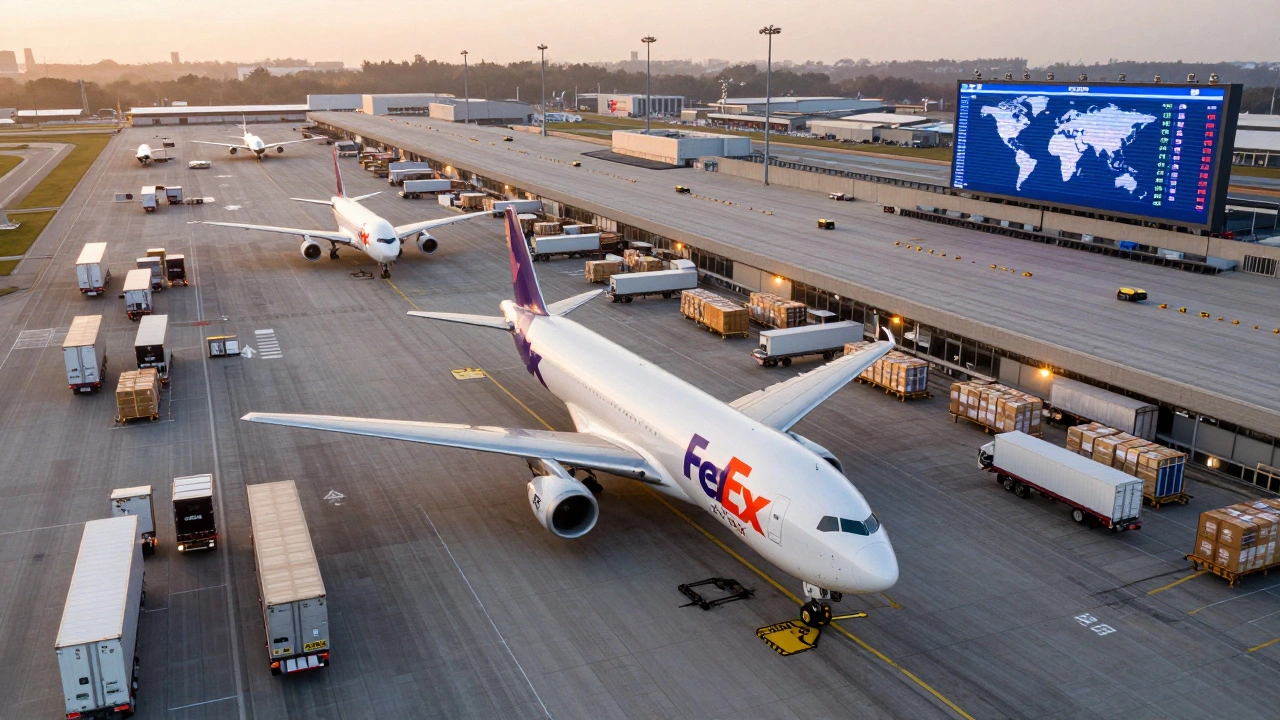
When you think of the biggest logistics company, you might picture trucks rolling through cities, planes landing at airports, or warehouses humming with activity. But size isn’t just about how many vehicles a company owns-it’s about revenue, global reach, employees, and the sheer volume of packages moved every day. As of 2025, the title of the world’s largest logistics company goes to FedEx, based on total revenue and global infrastructure.
FedEx Leads by Revenue and Scale
FedEx generated over $92 billion in revenue in 2024, according to its annual report. That’s more than any other logistics firm in the world. It moves more than 17 million packages daily across 220 countries and territories. Its fleet includes over 680 aircraft and 190,000 ground vehicles. The company employs roughly 570,000 people worldwide.
FedEx didn’t get here by accident. It built a network that connects everything from small online sellers to Fortune 500 manufacturers. Its Express, Ground, Freight, and Trade Technologies divisions work together like gears in a machine. Even during peak seasons like Black Friday or Chinese New Year, FedEx keeps its systems running with near 99% on-time delivery accuracy for priority shipments.
UPS Comes in Second
United Parcel Service (UPS) is FedEx’s closest rival. In 2024, UPS reported $90.5 billion in revenue and moved about 25 million packages daily-more than FedEx on volume, but slightly less in revenue. Why? Because UPS leans harder into ground shipping, which is cheaper per package but brings in less money than FedEx’s premium air services.
UPS has a massive ground network in North America, with over 120,000 delivery vehicles and 500,000 employees. It also owns its own airline, UPS Airlines, which operates more than 280 aircraft. But unlike FedEx, UPS doesn’t have as strong a presence in international express freight. Its global revenue share is about 15% lower than FedEx’s.
DHL Is the Global Powerhouse
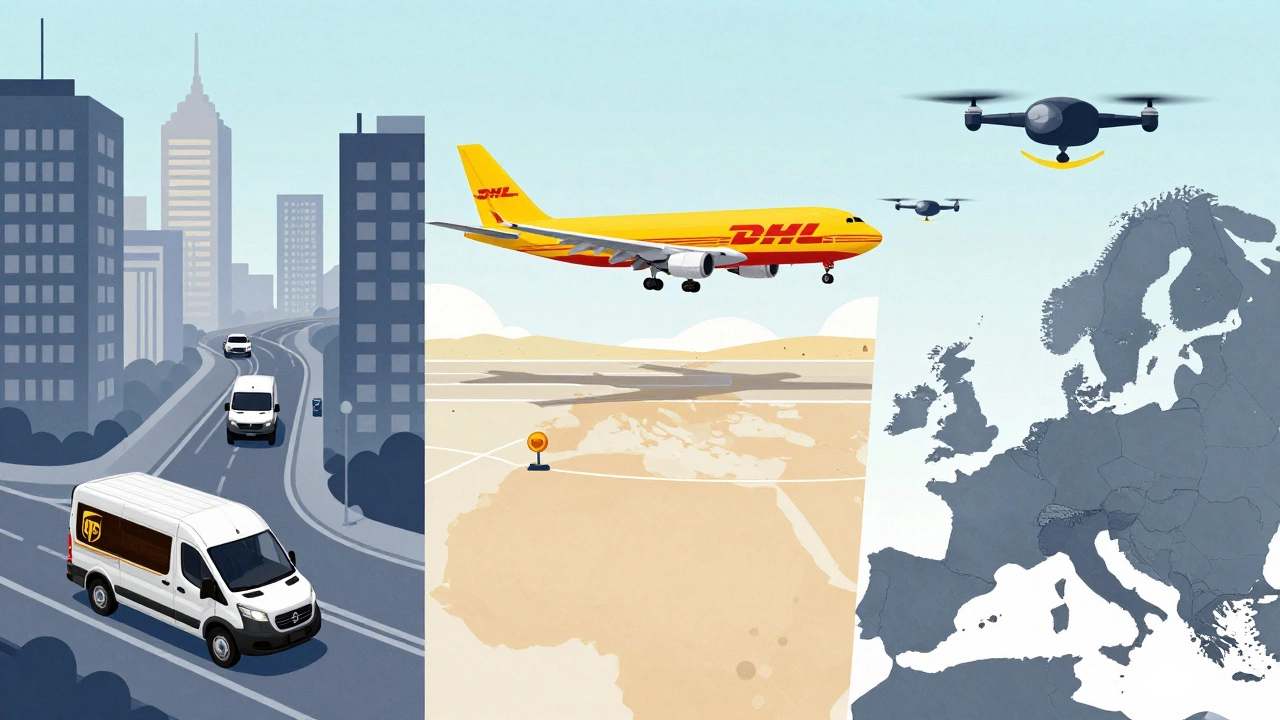
If you’re shipping something from Berlin to Bangkok or from São Paulo to Shanghai, DHL is often the go-to. Deutsche Post DHL Group, the parent company, posted $88 billion in revenue in 2024. But here’s the twist: DHL’s revenue is split across multiple brands. DHL Express handles international air freight, DHL Global Forwarding manages freight forwarding, and DHL Supply Chain runs warehouses and fulfillment centers.
What makes DHL stand out is its unmatched international coverage. It operates in over 220 countries and territories, even in places where FedEx and UPS have limited access. DHL has a stronger foothold in Africa, the Middle East, and parts of Asia. It also owns the largest international express delivery network in the world by number of countries served.
But DHL’s parent company, Deutsche Post, is a German state-backed entity. That means it’s not purely driven by shareholder returns like FedEx or UPS. This gives it flexibility to invest in long-term global infrastructure-even in low-margin markets.
Why Size Matters Beyond the Numbers
Being the biggest isn’t just about bragging rights. It affects how businesses operate. If you’re a small e-commerce brand selling on Amazon or Shopify, you want a carrier that can handle sudden spikes in demand. FedEx’s network lets you ship from a warehouse in Ohio to a customer in Tokyo in under 48 hours. UPS gives you reliable ground delivery across the U.S. with next-day service to 99% of the population. DHL makes cross-border shipping less risky for businesses without local offices.
Big logistics companies also have more leverage with airports, customs agencies, and port authorities. They can negotiate better rates, faster clearance times, and priority handling. That translates into fewer delays and lower costs for their customers.
They also invest heavily in technology. FedEx’s SenseAware system tracks packages in real time with sensors that monitor temperature, humidity, and location. UPS uses AI to optimize delivery routes, saving millions of miles and gallons of fuel each year. DHL’s Robotics division runs automated warehouses in Germany and Singapore that can process 100,000 parcels per hour.
Other Major Players to Know
While FedEx, UPS, and DHL dominate the top three, other companies are growing fast:
- Amazon Logistics: Amazon now handles more than 5 billion shipments annually, mostly within the U.S. It’s not a public logistics company, but its private network rivals FedEx Ground in volume. It’s also expanding into international delivery.
- China Post: The world’s largest postal service by volume, moving over 10 billion parcels annually-mostly domestic. It’s a key player in cross-border e-commerce from China to the rest of the world.
- SF Express: China’s biggest private courier, with a revenue of $24 billion in 2024. It’s expanding rapidly in Southeast Asia and Europe.
- Maersk: While best known for ocean shipping, Maersk’s logistics division moved over $12 billion in freight services in 2024, including air, rail, and last-mile delivery.

What Happens When the Biggest Isn’t the Best?
Size doesn’t always mean better service. FedEx might be the biggest, but if you’re shipping a fragile item from Toronto to Montreal, UPS might be faster and cheaper. If you’re sending documents from London to Nairobi, DHL is often the only reliable option. And if you’re a small business with low volume, you might save money using regional carriers like OnTrac or Loomis.
Many companies now use multi-carrier shipping software to automatically pick the best option for each package-based on price, speed, and destination. That means the “biggest” company isn’t always the one you’ll use.
Who’s Rising Fast?
Amazon is the most disruptive force. It’s building its own air fleet, leasing cargo planes, and opening fulfillment centers in Europe and India. By 2027, analysts predict Amazon Logistics could surpass FedEx in daily package volume within North America.
Meanwhile, SF Express and JD Logistics are pushing hard into global markets, especially with the rise of cross-border e-commerce. Alibaba’s Cainiao Network, while not a carrier itself, connects hundreds of local logistics providers across 100+ countries using data and automation. It’s becoming the invisible backbone of global online shopping.
Final Take: It Depends on What You Need
So who’s the biggest logistics company? FedEx, by revenue and global infrastructure. But the answer changes depending on your needs. For speed and reliability in international express shipping, FedEx leads. For domestic ground delivery in the U.S., UPS wins. For global reach in tough markets, DHL is unmatched. And for e-commerce sellers, Amazon is quietly becoming the most important player of all.
The logistics industry isn’t a race to be the biggest. It’s a race to be the most reliable, the most flexible, and the most responsive. The top companies are all investing in automation, sustainability, and real-time tracking. The winner isn’t just the one with the most trucks-it’s the one that adapts fastest.
Is FedEx really the biggest logistics company in 2025?
Yes, as of 2025, FedEx is the largest logistics company by total revenue, with over $92 billion in annual income. It leads in global express shipping, air freight capacity, and international coverage. While UPS moves more packages daily and DHL has broader geographic reach, FedEx’s revenue and integrated network give it the top spot.
How does DHL compare to FedEx and UPS?
DHL, part of Deutsche Post DHL Group, has slightly lower revenue than FedEx but offers the most extensive international network, serving over 220 countries-even in remote or politically unstable regions. While FedEx and UPS focus heavily on North America and premium express services, DHL dominates in cross-border freight, customs clearance, and B2B logistics. It’s the go-to for businesses shipping outside major economies.
Why is Amazon considered a logistics giant even though it’s not a traditional carrier?
Amazon handles over 5 billion shipments annually through its own delivery network, including trucks, planes, and fulfillment centers. It’s bypassing traditional carriers for its core business, cutting costs and gaining control over delivery speed. While Amazon doesn’t sell logistics services to the public, its scale rivals FedEx and UPS in North America. By 2027, it could become the largest package mover in the region.
What makes a logistics company "biggest"-revenue, volume, or reach?
It depends on how you define "biggest." Revenue is the standard metric used in rankings (FedEx leads here). Package volume favors UPS. Geographic reach goes to DHL. For businesses, the most important factor is reliability and coverage in the regions they serve. There’s no single winner across all categories-each company excels in a different area.
Should I always choose the biggest logistics company for my business?
No. The biggest company isn’t always the best fit. Small businesses shipping domestically might save money with regional carriers like OnTrac or regional postal services. International sellers often benefit from DHL’s customs expertise. E-commerce brands using Amazon FBA don’t need third-party carriers at all. The key is matching the carrier’s strengths to your shipping needs-not just picking the largest name.