

International Shipping Cost & Transit Estimator
Transit Time: -- days
Estimated Cost: $--
Best for: Urgent replenishment, high-value electronics.
Transit Time: -- days
Estimated Cost: $--
Best for: Bulk goods, furniture, non-perishables.
Choosing the right method for international shipping isn't just about picking the cheapest rate. It’s a balancing act between speed, cost, reliability, and how much paperwork you’re willing to handle. Whether you’re sending a single package to a friend in Japan or managing a B2B supply chain across Europe, the "best" option changes drastically based on your specific needs.
In this guide, we break down the main pillars of global logistics: commercial carriers, postal services, and freight forwarding. We’ll look at real-world scenarios to help you decide what actually works for your situation in 2026.
Quick Summary / Key Takeaways
- Commercial Carriers (DHL, FedEx, UPS): Best for high-value, time-sensitive items. Fast but expensive.
- National Postal Services (Royal Mail, USPS): Best for low-cost, non-urgent retail orders. Slower but covers remote areas.
- Freight Forwarders: Essential for bulk goods (LCL/FCL). They consolidate shipments to save money.
- Air vs. Sea: Air is 3-5 days; Sea is 30-45 days. Choose based on inventory turnover rates.
- Customs is King: The biggest delay risk isn’t transport; it’s documentation errors at the border.
Understanding the Three Main Shipping Channels
When people ask "what is best," they usually mean one of three things: speed, cost, or reliability. These three channels serve different jobs.
Commercial Express Carriers are private logistics companies that offer door-to-door delivery with guaranteed timelines. Companies like DHL Express, FedEx, and UPS dominate this space. They own their aircraft and trucks, which means they control the entire journey. This control comes at a premium price, but it buys you predictability. If you need a server part in Berlin by Thursday morning, this is your only real option.
National Postal Services are government-backed entities that provide universal mail coverage. In the UK, that’s Royal Mail; in the US, it’s USPS. Their strength is reach-they can deliver to rural villages where private couriers won’t go. Their weakness? Tracking can be spotty once the parcel leaves the origin country, and delays are common during peak seasons like Christmas.
Freight Forwarders are logistics intermediaries who consolidate cargo from multiple shippers into larger containers. Think of them as travel agents for cargo. You don’t ship directly with Maersk or MSC; you ship with a forwarder who has a contract with those lines. This model is crucial for businesses moving pallets or full truckloads, not individual boxes.
Air Freight vs. Sea Freight: The Speed-Cost Trade-off
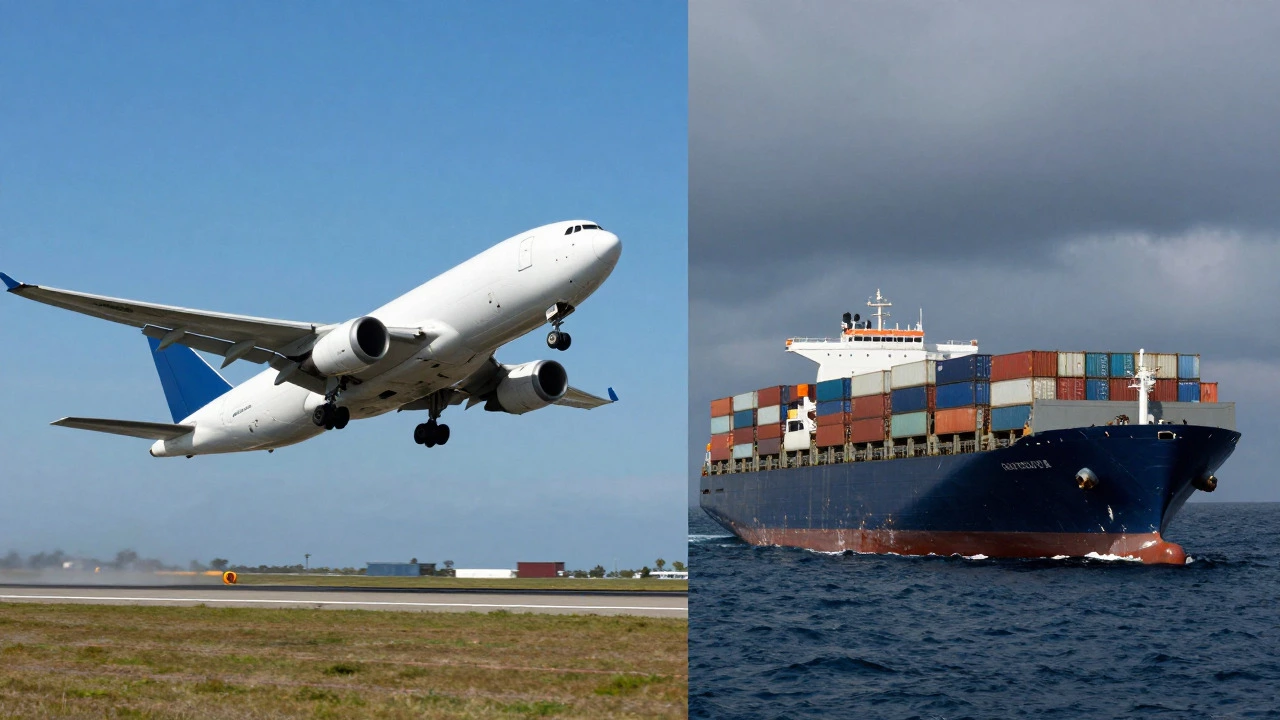
If you’re moving more than 100kg, the decision usually comes down to Air versus Sea. There is no middle ground that makes sense economically.
| Attribute | Air Freight | Sea Freight (FCL) |
|---|---|---|
| Transit Time (UK to USA) | 3-5 days | 7-10 days (ocean) + 5-7 days (port handling) |
| Cost per kg | $3.00 - $8.00+ | $0.50 - $1.50 (for large volumes) |
| Best For | Perishables, electronics, urgent replenishment | Furniture, raw materials, non-perishable goods |
| Customs Complexity | High (fast processing required) | Moderate (more time to fix docs) |
| Risk Profile | Low damage risk, high cost risk | Higher damage risk, low cost risk |
Here’s a rule of thumb: if your product has a high margin and customers expect fast delivery, use Air. If you’re selling commodity goods where a two-week delay doesn’t hurt sales, use Sea. Many successful e-commerce brands use a hybrid model-keeping safety stock in local warehouses via Sea, and using Air for emergency restocks.
The Hidden Cost: Customs Clearance
Most first-time shippers underestimate customs. It’s not just about paying duties; it’s about data accuracy. A wrong HS Code (Harmonized System Code) can hold your shipment at the border for weeks.
For international shipping, the Incoterms matter. Are you shipping DDP (Delivered Duty Paid) or DAP (Delivered At Place)?
- DDP: You pay all duties and taxes before the customer sees the bill. This provides a better customer experience but requires you to calculate tax accurately upfront.
- DAP: The customer pays duties upon arrival. This is cheaper for you initially but often leads to abandoned packages if the customer refuses to pay unexpected fees.
In 2026, digital customs platforms have made this easier. Tools integrated with Shopify or WooCommerce can auto-generate invoices with correct HS Codes, reducing manual error. If you’re doing volume, consider hiring a licensed customs broker. They charge a fee, but their ability to clear goods quickly saves far more in storage and penalty costs.
Choosing Based on Your Business Model
There is no single "best" method. The right choice depends on who you are.
For Solo E-commerce Sellers (Under 50 Orders/Month)
Use National Postal Services (e.g., Royal Mail Tracked 48) for standard items. It’s cheap, and tracking is sufficient for most consumers. Switch to a commercial carrier (like DHL eCommerce) only when you start seeing complaints about lost parcels or slow delivery times. Don’t over-engineer your logistics until revenue demands it.
For Growing Brands (50-500 Orders/Month)
This is where multi-carrier software becomes essential. You need to route orders automatically based on destination and weight. For example, send small light items via Post, and heavier items via DPD or UPS. Negotiate rates now. At this volume, you qualify for discounted contracts that drop prices by 15-20% compared to public rates.
For B2B Importers
You need a Freight Forwarder. Look for one with strong relationships in your specific trade lane (e.g., China to UK). Ask them about their "last mile" partners. A great ocean line is useless if their local delivery partner in Manchester is unreliable. Check their insurance coverage too-standard marine insurance often excludes certain types of damage unless specifically endorsed.

Common Pitfalls to Avoid
- Ignoring Battery Regulations: Lithium batteries require special labeling and packaging. If you ship electronics without declaring them, customs may seize the cargo. Always check IATA regulations for air freight.
- Bad Packaging: International transit is rougher than domestic. Use double-boxing for fragile items. A crushed box looks unprofessional and increases return rates.
- Assuming Free Zones are Easy: Using bonded warehouses can save on import duties, but the compliance requirements are strict. One audit failure can wipe out years of savings.
- Not Insuring High-Value Goods: Carrier liability is capped (often around €62 per kg for air). If you’re shipping a laptop worth $1,500, buy additional insurance. It’s cheap peace of mind.
How to Evaluate Logistics Partners
Don’t just look at the rate card. Ask these three questions before signing a contract:
- What is your average customs clearance time? If they say "instant," be skeptical. Realistically, it takes 24-48 hours. Ask for data on their last quarter.
- Who handles the last mile? Is it their own fleet or a subcontractor? Subcontractors can change quality overnight.
- What happens if there’s a claim? Get the claims process in writing. How many days do you have to file? What proof is needed?
Reliability beats price. A carrier that is 95% reliable and costs 10% more will save you more in customer support costs and lost sales than a 85% reliable cheap option.
Is DHL always the fastest option for international shipping?
Generally, yes, for express door-to-door service. However, for very heavy cargo or specific routes, competitors like FedEx or UPS might offer comparable speeds at lower prices. Always compare transit times for your specific origin-destination pair rather than assuming one brand is universally fastest.
What is the difference between LCL and FCL shipping?
LCL (Less than Container Load) means you share a container with other shippers. It’s cheaper for smaller volumes but slower because the container must be filled and emptied. FCL (Full Container Load) means you rent the whole container. It’s faster and safer for your goods, but you pay for the entire space even if it’s not full.
Do I need a customs broker for every shipment?
No, but it helps. For low-value personal items, the carrier often handles entry. For commercial imports, especially those with complex HS codes or high duty rates, a licensed broker reduces the risk of errors. Many freight forwarders include basic brokerage services in their quotes.
How long does international shipping typically take in 2026?
Express air shipping takes 3-5 business days. Standard air takes 5-8 days. Sea freight varies by route but generally takes 15-45 days plus port handling time. These times can fluctuate due to seasonal peaks and geopolitical events.
Which is better for e-commerce: DDP or DAP?
DDP (Delivered Duty Paid) is usually better for consumer-facing e-commerce because it prevents surprise charges for the customer. However, it requires accurate tax calculation. DAP is better for B2B transactions where the buyer has their own import capabilities.