

UK E-commerce Delivery Time Calculator
Estimated delivery time will appear here
How This Works
Based on UK e-commerce logistics data:
- Urban areas: 1-2 business days
- Rural areas: 2-4 business days
- Same-day delivery only available in major cities before 12pm
- Holiday peaks can add 1-2 days
Ever wonder how that package you ordered at 11 p.m. shows up at your door by noon the next day? It’s not magic. It’s e-commerce logistics - a tightly tuned machine that moves products from warehouses to your doorstep, often faster than you can change your mind about buying them. This system doesn’t just happen. It’s built on layers of planning, technology, and human effort working in sync across continents.
Step 1: The Order Triggers the Whole System
When you click "Buy Now" on an online store, that’s not the end of your interaction with logistics - it’s the starting gun. The order gets sent instantly to the seller’s order management system. From there, it’s routed to the nearest fulfillment center. This isn’t just a warehouse with boxes stacked high. Modern fulfillment centers use automated systems to find, pick, and pack items in under 10 minutes. Some even use robots that glide under shelves to pull products off. The system knows exactly where every item is, down to the bin on the third aisle of Zone C.Speed matters. If you order from Amazon, Walmart, or even a small Shopify store with same-day shipping, the system has already predicted you might want that item. Inventory is stocked closer to you - sometimes in mini-warehouses just outside major cities. That’s why your order from Manchester might come from a depot in Stoke-on-Trent, not a central warehouse in Birmingham.
Step 2: Packing and Labeling - Precision at Scale
Once the item is picked, it goes to a packing station. Here, machines don’t just slap on a label. They calculate the perfect box size, add cushioning only where needed, and print a shipping label with a barcode that contains your address, tracking number, delivery window, and even the route the driver will take. Each label is scanned at every checkpoint - from the packing belt to the delivery van.Some companies use AI to predict how fragile an item is based on its shape and material, then automatically choose the right packaging. A glass vase gets bubble wrap and a rigid box. A T-shirt gets a poly mailer. This cuts waste, lowers shipping costs, and reduces damage claims. In 2025, the average e-commerce return rate due to damaged goods dropped to 2.1% - down from 4.3% in 2020 - thanks to smarter packing.
Step 3: The Hub Network - Where Packages Change Hands
Your package doesn’t fly straight from the warehouse to your house. It goes through a network of sorting hubs. These are massive buildings, often the size of football fields, where conveyor belts move thousands of packages per hour. Robots and scanners read barcodes and sort items by destination postcode. A package from London might pass through three hubs before reaching you: one for regional sorting, one for national routing, and one for final local delivery.Major carriers like DHL, UPS, and Royal Mail operate their own hub networks. But many small online sellers use third-party logistics (3PL) providers - companies that handle storage, packing, and shipping on behalf of dozens or hundreds of brands. These 3PLs are the hidden backbone of small e-commerce businesses. They negotiate lower shipping rates because they move so much volume, and they integrate directly with Shopify, WooCommerce, and eBay to automate everything.

Step 4: Last Mile Delivery - The Hardest Part
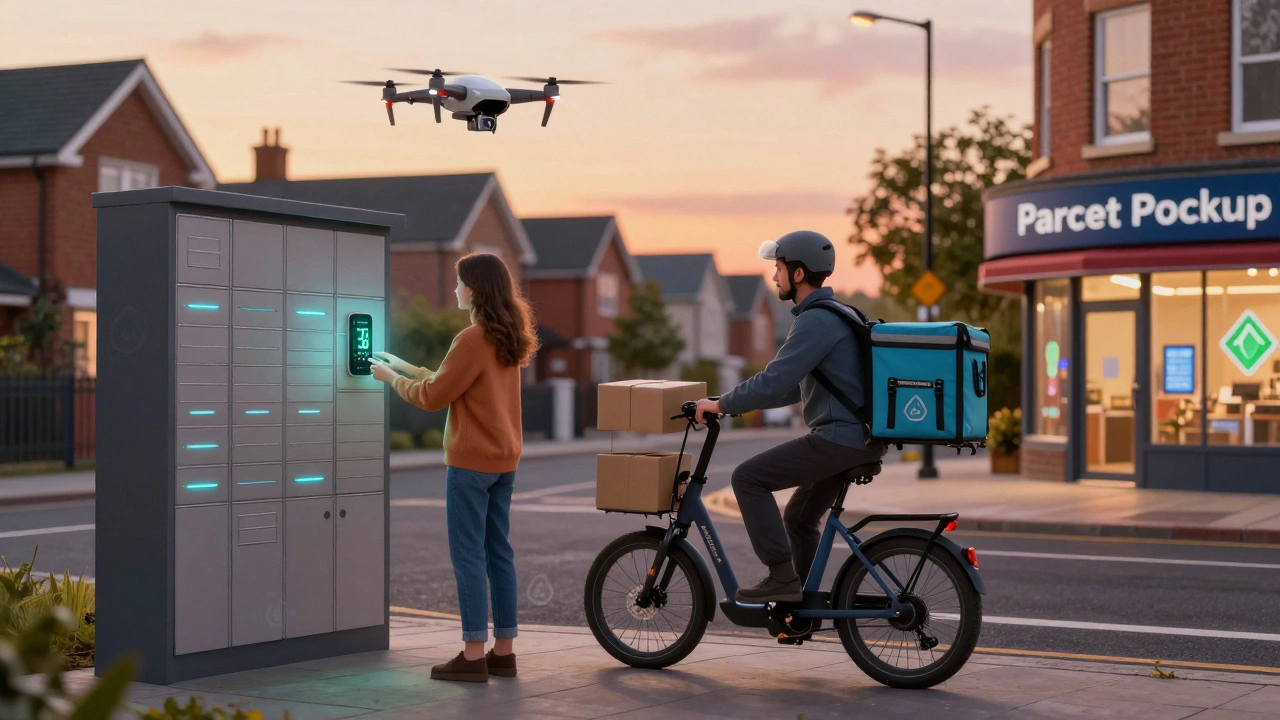
The last mile - the final leg from a local depot to your door - is the most expensive and complex part of the whole journey. It accounts for nearly 30% of total shipping costs. Why? Because delivering to individual homes means driving slow, stopping often, and dealing with missed deliveries.Companies are getting creative. In Liverpool, some delivery vans now carry lockers that open with a code sent to your phone. Others use local pickup points - corner shops, newsagents, or even post offices - where you can collect your package anytime. Some startups are testing drones for rural areas, and electric cargo bikes for city centers. In Manchester, a pilot program cut delivery emissions by 60% by switching to bike couriers for packages under 5kg.
Timing matters too. You can now choose delivery windows - 9 a.m. to 1 p.m., or 6 p.m. to 9 p.m. - and get real-time updates on your driver’s location. If you’re not home, the driver might leave it with a neighbor, drop it in a secure porch box, or reschedule automatically.
Step 5: Returns - The Reverse Logistics Challenge
Returns are a huge part of e-commerce. About 30% of online orders get returned - sometimes because the item didn’t fit, other times because it was bought just to try it. Reverse logistics - the process of getting returned items back to the warehouse - is just as complex as forward shipping.Many companies now offer free returns. You print a label, drop the box at a local carrier point, and it’s scanned back into the system. But here’s the catch: returned items aren’t always resold as new. If the packaging is damaged, the item might go to a refurbishment center. If it’s been worn or opened, it might be sold as "open box" at a discount. Only about 50% of returns go back on the shelf untouched.
Some retailers are using AI to predict which items are most likely to be returned. If a certain dress has a 70% return rate, they might change the product description, add more photos, or offer virtual try-on tools. Reducing returns isn’t just about saving money - it’s about cutting waste and carbon emissions.
Technology Powers Every Step
None of this works without software. Warehouse management systems (WMS) track inventory in real time. Transportation management systems (TMS) plan the most efficient routes. Predictive analytics forecast demand so warehouses stock the right items in the right places. APIs connect online stores to logistics providers so orders flow automatically.For example, a small business in Leeds selling handmade candles might use ShipStation to connect with Royal Mail, DPD, and Hermes. When an order comes in, ShipStation automatically picks the cheapest and fastest carrier based on your location, prints the label, and updates the customer. No manual entry. No errors. No delays.
Even tracking has gotten smarter. You don’t just see "Out for Delivery" anymore. You get alerts like: "Your driver is 2 blocks away. Estimated arrival: 4:12 p.m." That’s because GPS data, traffic patterns, and delivery history are all fed into algorithms that predict arrival times with 90% accuracy.
What Happens When Things Go Wrong?
Delays happen. Weather, strikes, customs holdups, system crashes - they all disrupt the flow. But the best logistics networks have backups built in. If a hub in Birmingham shuts down, packages are rerouted through Manchester or Leicester. If a driver is sick, another one from a nearby depot picks up the route.Companies also use real-time dashboards to monitor performance. If more than 5% of deliveries in a postcode are late, the system flags it. Managers investigate - maybe the route needs adjusting, or the van is overloaded. This isn’t guesswork. It’s data-driven problem solving.
Why This Matters for You
If you’re a shopper, you get speed, convenience, and transparency. If you’re a seller, you get access to global markets without owning a fleet of trucks or hiring a logistics team. But behind every delivered package is a system designed to handle millions of decisions per day - with near-perfect accuracy.It’s not perfect. There are still delays, lost packages, and environmental costs. But the system keeps improving. In 2025, the average UK e-commerce delivery took 1.8 days - down from 3.2 days in 2020. Carbon emissions per parcel dropped 22% thanks to electric vehicles and optimized routing.
What you see as a simple delivery is actually the result of years of engineering, data science, and human coordination. And it’s only getting smarter.
How long does e-commerce logistics usually take in the UK?
Most e-commerce orders in the UK arrive within 1 to 3 business days. Same-day or next-day delivery is common in major cities like London, Manchester, and Birmingham, especially if you shop with retailers that have local fulfillment centers. Rural areas may take 2 to 4 days, depending on carrier coverage and weather conditions.
What’s the difference between a warehouse and a fulfillment center?
A warehouse stores goods for long-term inventory, often in bulk. A fulfillment center is designed for fast order processing - it picks, packs, and ships individual customer orders. Fulfillment centers are optimized for speed, with automated sorting, packing stations, and direct integration with online stores. Most e-commerce businesses use fulfillment centers, not traditional warehouses.
Can small businesses handle their own logistics?
Yes, but it’s rarely efficient. Handling your own shipping means buying packaging, printing labels, driving to drop-off points, and managing returns. Most small sellers use third-party logistics (3PL) providers like ShipBob, Deliverr, or Royal Mail’s Business Services. These companies offer integrated software, discounted shipping rates, and automated tracking - all for a flat fee per order.
Why do some deliveries take longer during holidays?
During holiday peaks like Christmas or Black Friday, order volumes can spike 300% or more. Carriers and fulfillment centers get overwhelmed. Even with extra staff and extended hours, sorting hubs and delivery routes reach capacity. That’s why many retailers stop accepting orders days before major holidays - to avoid delays. Planning ahead is key.
How do returns affect the environment?
Returns create extra trips, packaging waste, and emissions. A single returned item can generate up to 50% more carbon than a regular delivery because it travels twice - once to you, once back. Many retailers now encourage exchanges over returns, offer store credit, or donate unsellable items. Choosing to keep an item you’re unsure about helps reduce this impact.
What role does AI play in modern logistics?
AI predicts demand so warehouses stock the right products in the right locations. It optimizes delivery routes to save fuel and time. It even recommends the best packaging for each item to reduce damage and waste. Some systems can forecast which customers are likely to return items, helping stores adjust product listings before the sale. AI doesn’t replace people - it helps them work smarter.
What’s Next for E-commerce Logistics?
The future is faster, greener, and more automated. Electric delivery vans are becoming standard in city centers. Autonomous delivery robots are being tested in university campuses and housing estates. AI will soon predict not just what you’ll buy, but when you’ll need it - and ship it before you order.One thing won’t change: the human element. Behind every barcode scan and delivery notification are warehouse workers, drivers, and customer service teams keeping the system running. Logistics isn’t just about technology - it’s about people making it work, day after day.