
SAP Terminology Decoder Quiz
Loading question...
Select an answer to continue.
You’re sitting in a meeting room, trying to source new warehouse solutions, and someone drops the phrase "SAP S/4HANA." You nod along, but internally you’re panicking. Is that the old system? Did they change the company name again? It’s a common mix-up because SAP has spent decades evolving from a niche German database project into a global tech giant. The short answer? The company is still called SAP. But the software suite people often refer to as "just SAP" has undergone several major rebrands, which is where the confusion really starts.
If you work in logistics or supply chain, knowing the difference between the company brand and the specific product modules saves you from awkward procurement conversations. Let’s clear up exactly what the company is called, why the software names keep shifting, and how this impacts your daily operations in the warehouse.
The Company Name Hasn’t Changed (But the Legal Structure Has)
First things first: the company itself is still SAP. Originally founded in 1972 in Weinheim, Germany, by five former IBM employees, the acronym stood for Systemanalyse Programmentwicklung (System Analysis Program Development). Over time, the English translation became System Applications and Products. That was the original identity. However, in 2014, the corporate structure changed significantly when it merged with other entities to become SAP SE. The "SE" stands for Societas Europaea, a public company registered under European Union law. So, legally, you might see contracts signed with "SAP SE," but everyone in the industry still calls them SAP. Don’t let the legal suffix throw you off; it’s the same organization you’ve known for thirty years.
Why Do People Ask "What is SAP Called Now?"
The question usually isn’t about the company logo. It’s about the software. For years, businesses ran on SAP R/3, which was the gold standard for enterprise resource planning (ERP) in the 1990s and early 2000s. Then came SAP ECC (ERP Central Component), which replaced R/3 around 2005. Many warehouses are still running ECC today, even though SAP has officially ended mainstream maintenance for it. When vendors try to sell you an upgrade, they say, "You need to move from ECC to S/4HANA." To a non-technical manager, this sounds like a completely different product. It’s not. It’s the next generation of the same core platform, rebuilt to run on the HANA in-memory database.
This naming shift creates anxiety. Managers worry their customizations will break. They wonder if their barcode scanners will talk to the new system. The truth is, SAP S/4HANA is designed to be backward compatible with many existing processes, but it requires a strategic migration plan. If you hear "S/4HANA," think "modernized SAP," not "new unknown vendor."
The Warehouse Module: From WM to EWM
Since we’re talking about warehouse solutions, here is the critical piece of information that actually changes your job title and daily tasks. In older versions of SAP (like ECC), the module used for managing inventory locations was called SAP WM (Warehouse Management). It was robust but rigid. It handled bin locations and picking lists well enough for traditional pallet-based operations.
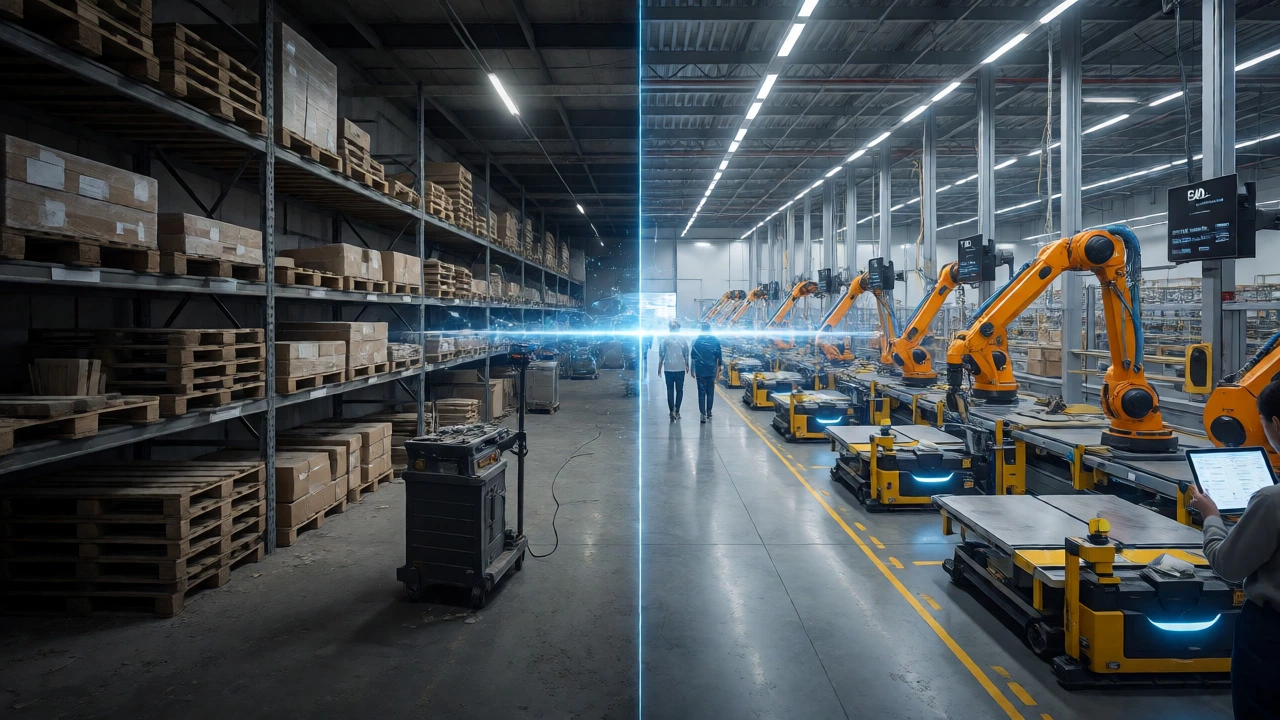
In the newer S/4HANA environment, SAP has pushed customers toward SAP EWM (Extended Warehouse Management). This is the big switch. EWM is more flexible, supports complex automation (like robotic arms and automated guided vehicles), and integrates better with mobile devices. If your current setup uses WM, and a consultant asks, "Are you moving to EWM?", they aren’t asking about the company name. They are asking about your operational architecture. EWM allows for wave management, labor tracking, and integration with Internet of Things (IoT) sensors in real-time. WM is being phased out for large enterprises, so if you’re building a new distribution center in Liverpool or anywhere else, EWM is likely what you’ll deploy.
| Feature | SAP WM (Legacy) | SAP EWM (Modern) |
|---|---|---|
| Complexity | Low to Medium | High (requires specialized training) |
| Automation Support | Limited native support | Built-in MFS (Material Flow System) |
| Mobile Integration | Basic RF screens | Native Fiori apps and Android/iOS support |
| Status | Maintenance only | Primary strategic direction |
Other Names You Might Hear (and Ignore)
SAP has acquired dozens of companies over the years, leading to a confusing alphabet soup of acronyms. You might hear about Ariba for procurement, Concur for travel expenses, or SuccessFactors for HR. These are all part of the SAP ecosystem now, but they aren't "SAP" in the traditional ERP sense. If a vendor says, "We use SAP Ariba for sourcing," they mean they use the cloud-based marketplace tool, not necessarily the core warehouse logic.
There is also SAP Business One. This is crucial for small-to-medium enterprises (SMEs). If you run a smaller fulfillment hub, you probably don’t need the heavy machinery of S/4HANA. Business One is lighter, cheaper, and easier to implement. Sometimes people ask, "Is Business One still called SAP?" Yes, it is. It’s just a different product tier. Don’t let sales reps confuse you by implying one is "better" than the other; they serve different revenue brackets.

How to Talk to Your IT Team Without Looking Clueless
Next time you’re discussing logistics software upgrades, use these precise terms to show you know your stuff:
- Ask about the version: "Are we staying on ECC or migrating to S/4HANA?" This determines your budget and timeline.
- Clarify the warehouse engine: "Will we retain WM functionality or transition to EWM?" This affects your staff training needs.
- Check the interface: "Are we using SAP Fiori for the user interface?" Fiori is the modern, tile-based look that works on tablets, unlike the gray, text-heavy screens of the past.
Understanding these distinctions helps you avoid buying shelfware-software that sits on a server unused because it doesn’t fit the workflow. SAP is powerful, but it’s notorious for requiring customization. Knowing the right names helps you demand the right features.
Why the Name Game Matters for Supply Chain Resilience
Supply chains are fragile. When a disruption hits-like a port strike or a raw material shortage-you need visibility. Older SAP systems provided data, but often with delays. Newer iterations, powered by the HANA database, process transactions in memory rather than on disk. This means real-time inventory counts. If you’re still calling your system "the old SAP" and ignoring the capabilities of S/4HANA, you’re leaving efficiency on the table. The name change signals a capability upgrade. It’s not just marketing fluff; it’s a technical leap that allows for predictive analytics. Imagine knowing a shipment will be late before it leaves the factory floor. That’s what the modern stack offers.
So, no, SAP didn’t rename itself to something unpronounceable. It kept its brand strong while refreshing its engines. Whether you call it SAP SE, S/4HANA, or just "the system," the key is understanding which version is driving your trucks and stacking your pallets.
Did SAP change its company name?
No, the company is still widely known as SAP. Legally, it operates as SAP SE (Societas Europaea) since 2014, but the brand remains SAP.
What is the difference between SAP ECC and SAP S/4HANA?
ECC is the legacy on-premise ERP suite. S/4HANA is the next-generation suite built specifically for the SAP HANA in-memory database, offering real-time analytics and simplified data models.
Is SAP WM the same as SAP EWM?
No. WM (Warehouse Management) is the legacy module. EWM (Extended Warehouse Management) is the advanced successor designed for complex, automated warehouse environments and is the future-proof option in S/4HANA.
Do I need to learn a new system if my company upgrades to S/4HANA?
Yes, but not entirely. The underlying logic is similar, but the user interface (Fiori) looks different, and EWM functions require new training compared to the old WM screens.
What does SAP stand for?
Originally, it stood for Systemanalyse Programmentwicklung (German for System Analysis Program Development). In English contexts, it is often referred to as System Applications and Products.