Shipping Speed & Cost Estimator
Select your shipping parameters below to see which service is faster, more reliable, or better value for your specific situation.
Recommendation
Please fill out the form to see recommendations.
FedEx 2Day
--
--
--
USPS Priority Mail
--
--
--
Why this choice?
- Analysis will appear here.
Enter details to compare shipping options.
You need a package to arrive in two days. You stare at the shipping calculator, torn between USPS Priority Mail and FedEx 2Day. The price difference might be negligible today, but what about reliability? What if one gets stuck in a sorting facility while the other flies overnight? Most people assume "Priority" means faster than "Standard," but when you compare it directly to a dedicated express service like FedEx, the answer isn't always obvious.
Here is the blunt truth: FedEx 2Day is generally faster and more reliable for strict two-day deadlines, especially over long distances. However, USPS Priority Mail often matches this speed for shorter distances or specific zones, frequently at a lower cost. But "faster" is a dangerous word in logistics. It depends entirely on where your package starts, where it ends, and what day of the week you ship it. Let’s break down exactly how these two services stack up so you don’t get burned by a late delivery.
The Core Difference: Network vs. Last Mile
To understand the speed, you have to look under the hood. These aren't just different brands; they are fundamentally different logistical machines.
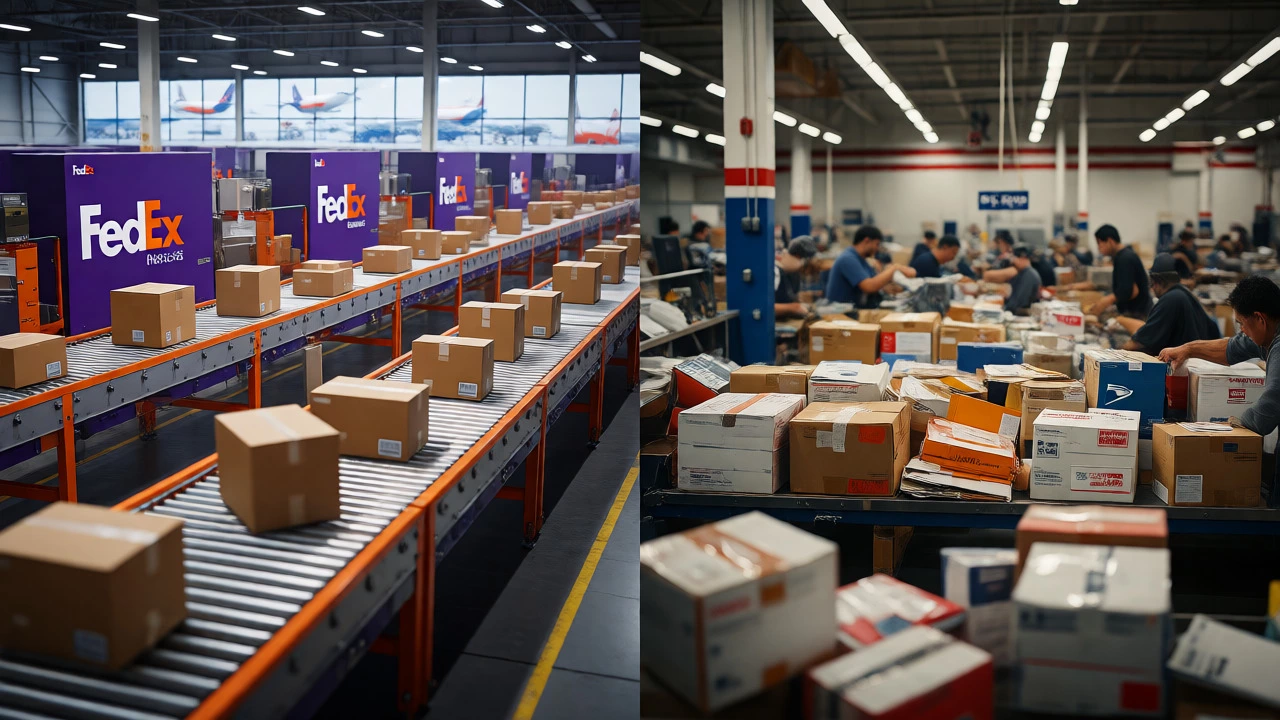
FedEx operates a private, integrated network. They own the planes, the trucks, the sorting hubs, and the drivers. When you buy FedEx 2Day, your package enters a closed loop designed specifically for speed. It moves from a local hub to a regional sort center, then potentially onto a cargo plane, and finally to another regional hub before hitting a local van. This vertical integration allows FedEx to control every minute of transit.
USPS Priority Mail works differently. It uses a hybrid model. While USPS owns its own aircraft (the blue-and-red planes) and many sorting facilities, it relies heavily on commercial airlines for air transport in certain lanes and partners with third-party carriers for some last-mile deliveries in remote areas. More importantly, USPS has a massive advantage in density. They deliver to every address in the US, including PO Boxes and rural routes that FedEx might charge extra for or take longer to reach. But because their network is shared with millions of standard mail pieces, priority packages can sometimes get deprioritized during peak volume spikes, like right before Christmas.
Speed Breakdown: Zone by Zone
Shipping speed isn't uniform. It scales with distance. Both companies use "zones"-a system that divides the country into rings based on distance from the origin zip code. Here is how the timelines typically play out in 2026.
| Distance / Zone | FedEx 2Day | USPS Priority Mail | Winner |
|---|---|---|---|
| Zones 1-2 (Local/Intra-state) | Next Business Day (often arrives next day) | 1-2 Days | Tie (FedEx slightly more consistent) |
| Zones 3-4 (Regional, e.g., NY to FL) | 2 Business Days | 1-3 Days | FedEx 2Day |
| Zones 5-8 (Cross-country, e.g., CA to NY) | 2 Business Days (guaranteed) | 2-3 Days (no guarantee) | FedEx 2Day |
| Rural / Remote Areas | 2-3 Days (may incur surcharges) | 2-4 Days | Depends on specific route |
Notice the pattern? For cross-country shipments, FedEx 2Day is explicitly sold as a two-day product. If it doesn't arrive in two days, you usually get a refund. USPS Priority Mail estimates "1-3 business days." That three-day estimate is real. In my experience shipping electronics from California to New York, Priority Mail often lands on day three, whereas FedEx consistently hits day two. If you need it there by Tuesday, Priority Mail is a gamble. If you need it there by Thursday, Priority Mail saves you money.
The Hidden Factor: Cutoff Times and Weekends
Speed isn't just about how fast the truck moves; it's about when the clock starts ticking. This is where most shippers mess up.
FedEx 2Day has strict cutoff times. If you drop off a package after the local cutoff (usually between 5:00 PM and 7:00 PM depending on location), it doesn't start moving until the next morning. Worse, FedEx Ground and Express services do not operate on Sundays. So, if you ship on Friday afternoon via FedEx 2Day, your package sits in a warehouse all weekend. It likely won't arrive until Wednesday.
USPS Priority Mail also has cutoffs, but USPS delivers on Sundays for Priority Mail Express and often for regular Priority Mail in major metropolitan areas. Even if they don't deliver Sunday, they often process mail on weekends. This means a package dropped off Saturday morning via USPS might actually make progress, whereas the FedEx package is frozen in time. For weekend-sensitive deliveries, USPS often wins simply because their infrastructure runs seven days a week, even if the individual package speed is slower.

Reliability and Tracking Accuracy
A fast package that gets lost is worse than a slow package that arrives. Reliability is measured in on-time performance and tracking granularity.
FedEx provides detailed, real-time tracking updates. You see scans at each hub. If a scan is missing for six hours, you know something is wrong. Their on-time rate for 2Day services hovers around 95-98% according to industry data from sources like ShipStation and Shippo. Because they control the chain, accountability is clear. If it’s late, it’s on them.
USPS tracking is improving but remains less granular. You might see "Departed Sorting Facility" followed by nothing for 24 hours. This gap creates anxiety. More critically, USPS does not offer a money-back guarantee for standard Priority Mail. If it takes four days instead of two, you eat the cost. There is no recourse unless you paid for Priority Mail Express, which is a completely different, much more expensive product. If certainty matters more than saving $5, FedEx’s guarantee structure is superior.
Cost Analysis: Is Speed Worth the Premium?
Let’s talk numbers. As of late 2026, here is a rough comparison for a 2-pound box shipped from Chicago to Miami.
- FedEx 2Day: Approximately $22-$25. Includes insurance up to $100. Guaranteed delivery by end of day.
- USPS Priority Mail: Approximately $14-$16. No guaranteed delivery date. Estimated 1-3 days.
That $8 difference adds up. If you ship 50 packages a month, that’s $400. But consider the risk. If a Priority Mail package slips to day three and your client needed it on day two, did you save money or lose a customer? For high-stakes B2B transactions, the FedEx premium is an insurance policy against delay. For casual e-commerce sales where customers expect a 3-5 day window anyway, Priority Mail is the smarter financial choice.
When to Choose Which Service
Don’t guess. Use this decision tree.
Choose FedEx 2Day if:
- You are shipping cross-country (Zones 5-8).
- The deadline is absolute (e.g., legal documents, urgent replacement parts).
- You need a money-back guarantee for lateness.
- The destination is a major metro area where FedEx has dense coverage.
- You are shipping heavy items (over 5 lbs) where dimensional weight pricing favors FedEx’s negotiated rates for businesses.
Choose USPS Priority Mail if:
- You are shipping locally or regionally (Zones 1-4).
- The deadline is flexible (2-3 days is acceptable).
- You are shipping to a PO Box or APO/FPO military address (FedEx cannot deliver to PO Boxes without a street address workaround).
- You want free pickup from your home (USPS offers this readily; FedEx charges for residential pickup).
- Budget is the primary constraint.
Pro Tips for Maximizing Speed
Regardless of which carrier you pick, you can manipulate the timeline. First, always print labels early. Dropping a package at 4:55 PM is better than 5:05 PM. Second, avoid Monday drops. Mondays are notoriously congested for both carriers due to weekend backlog. If possible, ship on Tuesday or Wednesday for smoother transit. Third, check the weather. A snowstorm in the Midwest delays FedEx hubs significantly, but USPS might reroute via ground networks that remain operational. Check the carrier’s service alerts page before labeling.
Is Priority Mail Express faster than FedEx 2Day?
Yes, Priority Mail Express is significantly faster. It guarantees overnight or second-day delivery by noon or 3 PM, similar to FedEx Standard Overnight. However, it costs nearly twice as much as Priority Mail and is comparable in price to FedEx Standard Overnight, not FedEx 2Day. If you need true speed, compare Priority Mail Express against FedEx Standard Overnight, not FedEx 2Day.
Does FedEx 2Day deliver on Saturdays?
Not automatically. FedEx 2Day typically delivers on weekdays. Saturday delivery is available as an add-on service for an additional fee (usually $10-$15). Without paying for the Saturday option, a Friday shipment will not arrive until Monday or Tuesday. Always verify if Saturday delivery is included in your contract or selected at checkout.
Can I track USPS Priority Mail as accurately as FedEx?
It is close, but not identical. USPS provides tracking numbers and status updates, but the frequency of scans is lower. You may see fewer intermediate stops compared to FedEx’s detailed hub-by-hub tracking. Additionally, USPS tracking can sometimes lag by 12-24 hours during peak seasons, creating temporary "black holes" in visibility where the package appears stationary despite being in transit.
Which is cheaper for small lightweight packages?
For packages under 1 pound, USPS Priority Mail is almost always cheaper than FedEx 2Day. FedEx’s base rate for express services tends to be higher regardless of weight, whereas USPS has tiered pricing that benefits light items. If you are shipping envelopes or small padded mailers, stick with USPS unless you require a guaranteed delivery time.
What happens if my FedEx 2Day package is late?
You are eligible for a refund of the shipping charges. You must file a claim within 15 days of the scheduled delivery date. Note that this only refunds the shipping cost, not the value of the contents or any consequential damages. Keep your receipt and tracking number handy to streamline the claim process through the FedEx website.